Kit Selection & Capacity
The appropriate kit selection is determined by the number of subjects and the total displacement volume of the casting. For reference, the 3–4 Person Kit is dimensioned for a composition of three adult hands.
Volume Displacement Calculation: To ensure sufficient material, calculate the volume of the subjects including the desired length of the wrists/arms.
-
Use a graduated measuring vessel filled with water.
-
Submerge the subject’s hand (and arm section) to the 1-litre mark.
-
Remove the hand and record the displacement.
-
Aggregate the displacement for all participants to find the total volume.
Kit Capacities:
-
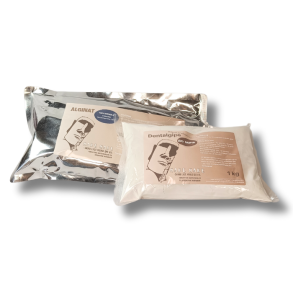
3–4 Person Kit: Includes 4 kg of High-Strength Plaster (Yields approx. 3 L casting compound).
-
4–5 Person Kit: Includes 6 kg of High-Strength Plaster (Yields approx. 5.5 L casting compound).
Application Protocol: Group Casting
Note: When using this specific method, do not follow the standard instructions on the packaging. Follow the technical protocol below to achieve the required viscosity.
-
Workspace Preparation: Cover the work area with plastic sheeting. Use rolled blankets under the plastic to create a perimeter "dam" to contain the alginate. Participants should be positioned around the table in the final casting pose.
-
Water Temperature: Use water at 27–30°C. This slightly extends the working time compared to standard specifications.
-
Mixing Ratio: Use approx. 950 ml water per 450 g bag of alginate to achieve a creamy consistency (e.g., 3.8 L for 4 bags / 5.7 L for 6 bags).
-
Fiber Integration: Add approx. 5 g of technical fiber to the water before adding the alginate powder. This increases the thixotropy (prevents sagging).
-
Blending: Add all bags simultaneously. Use an electric mixer (or a drill with a mixing paddle) for high-efficiency blending.
-
Application: Distribute the mixture over the subjects' hands. Ensure all voids and interstices are filled by pressing the material firmly into the gaps.
-
Reinforcement: Once the alginate has set, apply wet plaster gauze strips to create a supportive mother-mould. Reserve enough gauze to seal the "arm entry" points after the subjects have withdrawn.
-
Demoulding & Casting: Carefully extract the hands once the support shell is rigid. Seal the openings with gauze. Mix the High-Strength Plaster (330 ml water per 1 kg powder) and pour into the mould. Vibrate the mould during pouring to release entrapped air.
-
Finishing: Allow to cure for 2 hours. Remove the alginate carefully. Post-process the cast by removing surface nodules with a precision tool and sanding the base. Finish with ColourFix™ for a low-lustre sheen.
Technical Guide: Maternity/Belly Casting
Casting a pregnant belly requires a modified approach to manage the material on a vertical/curved surface.
Recommended Materials:
-
3–4 bags of Alginate (Normal or Slow)
-
3–4 kg High-Strength Plaster
-
Technical Fiber
-
Plaster Gauze (10 or 15 cm width – min. 4 rolls)
-
ColourFix™ for surface finishing
Maternity Protocol:
-
Preparation: Use a protective plastic apron for the subject. The subject should remain stationary and not participate in the mixing process.
-
High-Viscosity Mix: Follow the same 950 ml water/5 g fiber ratio as above. For large surface areas, a drill-mounted mixer is required.
-
Application: Apply the creamy alginate over the belly. Due to the vertical orientation, you must continuously "scoop" the material upward until it begins to set. Using "Slow" alginate provides more working time but requires longer stationary periods for the subject.
-
Casting options: You can either fill the mould completely for a solid cast or "slush cast" a thicker layer of plaster to create a hollow, bowl-like shell.
-
Curing: Allow at least 2 hours (ideally longer) before demoulding to ensure maximum structural integrity. Repair any surface pinholes with a high-viscosity plaster paste.


Customers who bought this product also bought